
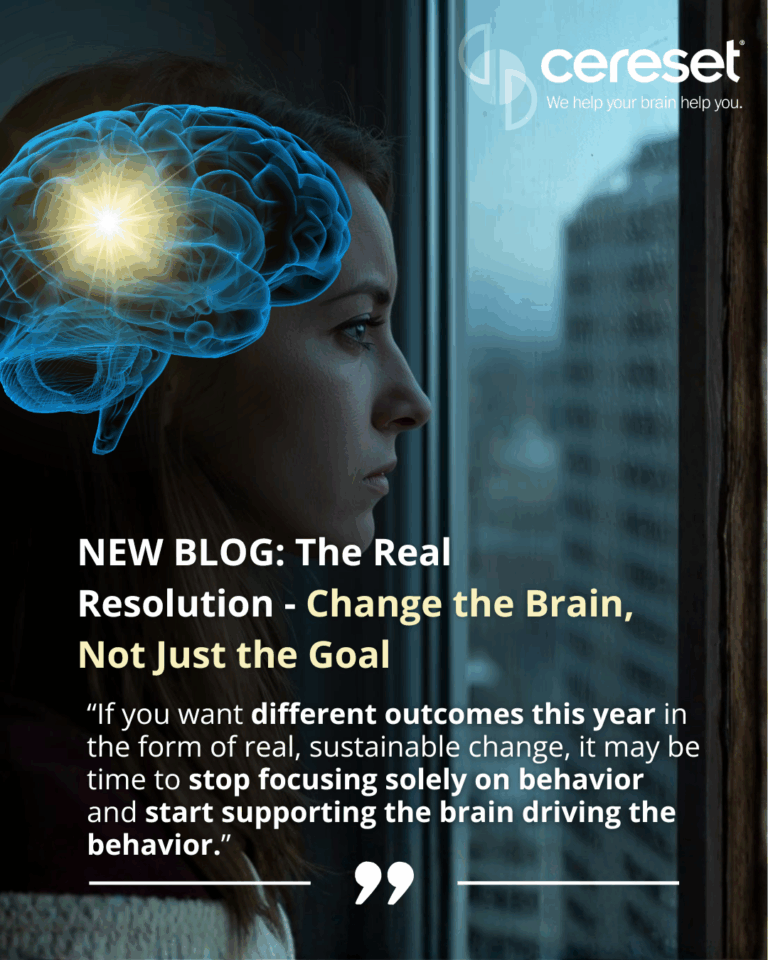
Change the Brain, Not Just the Goal
It’s the New Year, a time when millions of people pause, reflect, and set their sights on who they want to become. We set goals, define resolutions, and imagine a better version of ourselves.
Exercise more. Eat healthier. Be more disciplined. Be more present.
We begin with strong motivation and determination. And yet, by midyear, most resolutions quietly fade away, never fully realized.
Research shows that while many people maintain at least part of their resolutions for the first few months, long-term success drops sharply. In fact, it’s estimated that only 8–9% of people successfully achieve and sustain their New Year’s resolutions over time.
So why does such a deeply ingrained tradition so rarely lead to lasting change?
The issue isn’t a lack of discipline, desire, or willpower.
It’s an overstressed, overloaded brain that simply can’t perform.
If you want different outcomes this year in the form of real, sustainable change, it may be time to stop focusing solely on behavior and start supporting the brain driving the behavior.
THE BRAIN DRIVES EVERY RESOLUTION
Every habit, decision, emotional response, and follow-through effort begins in the brain. Motivation, impulse control, focus, emotional regulation, and consistency are all brain-based functions.
When the brain is balanced and flexible, change feels achievable and even exciting.
When the brain is stressed and dysregulated, even simple goals feel exhausting and overwhelming.
This happens because stress fundamentally alters how the brain operates. Under chronic stress, neural resources shift away from higher-level functions like thinking, reflection, focus, and self-regulation, and toward survival-based processing.
As a result, it becomes harder to:
- Stay consistent
- Follow through on intentions
- Regulate emotions
- Resist impulsive behaviors
- Sustain motivation over time
In short, stress biases the brain toward threat detection and habitual, reactive circuits rather than learning, planning, and execution.
STRESS LIMITS THE BRAIN’S ABILITY TO CHANGE
Chronic stress doesn’t just make life feel harder; it directly limits neuroplasticity, the brain’s ability to adapt, rewire, and form new patterns.
A highly stressed brain becomes rigid, relying heavily on existing circuits to conserve energy and maintain the status quo. At the same time, activity and plasticity decline in regions such as the prefrontal cortex and hippocampus, which are critical for:
- Insight
- Emotional regulation
- Decision-making
- New habit formation
The result? The brain becomes efficient at reacting and protecting, but poor at adapting and growing.
WHY WILLPOWER ISN’T ENOUGH
Most resolutions rely heavily on willpower, or what I like to call “white-knuckling it through life.” This approach involves forcing change through sheer effort and determination. While it can work temporarily, it demands constant energy, focus, and attention.
The problem with this strategy is simple: energy is a limited resource, and a stressed nervous system has significantly less of it than a non-stressed system.
When the energy runs out, so does the willpower.
Willpower may get resolutions started, but it rarely sustains them. This is why people often know exactly what they want to change yet feel stuck repeating the same patterns. The brain isn’t failing. In fact, the brain is doing exactly what it is designed to do in these conditions: conserve energy and prioritize safety over growth.
WHY RELEASING STRESS IMPROVES OUTCOMES
When the brain releases stress, it regains flexibility and frees up energy resources. This shift allows the brain to:
- Shift out of survival-based patterns
- Re-engage higher-level thinking and discernment
- Adapt more efficiently
- Learn new behaviors
- Sustain effort over time
A regulated brain doesn’t require constant self-control to do the “right” thing. Healthy behaviors feel more natural, less forced, and easier to maintain.
This is why people often report that once their brain is better regulated, changes they’ve struggled with for years suddenly feel not only manageable, but achievable.
OPTIMIZE THE BRAIN BEFORE CHASING THE GOAL
Rather than beating yourself up for another year of unmet resolutions, it may be more helpful to examine the root cause: an exhausted, overstressed system.
Optimizing brain function means:
- Releasing limiting stress patterns
- Improving nervous system regulation
- Enhancing the brain’s ability to adapt and change
- Freeing up vital energy resources
- Improving overall performance and resilience
When a strong foundation is in place, goals no longer feel like uphill battles. There’s finally a stable platform to launch from.
WHY A PERSONALIZED BRAIN-BASED APPROACH MATTERS
At Cereset, we recognize that no two brains are the same. Each brain holds stress differently, expresses imbalance uniquely, and adapts in its own way. For example, what shows up as anxiety for one person is not going to present the same in someone else.
That’s why personalized, brain-based approaches tend to be more effective than one-size-fits-all solutions.
Cereset sessions are tailored to your brain’s unique response, allowing it to recognize and release inefficient patterns on its own terms without force, medication, or external stimulation. This self-adjustment process supports meaningful change by working with the brain, not against it.
New Year’s resolutions often fail because we try to build new behaviors on top of an exhausted and depleted system, but when you begin by optimizing brain function and releasing stress:
- Focus improves
- Energy increases
- Emotional regulation strengthens
- Sleep deepens
- Follow-through becomes easier
- Goals feel aligned instead of draining
This year, instead of asking more of an already-stressed brain, consider supporting it first.
After all, when the brain functions better, everything else follows.
by Sonya Crittenden,
Director of Client Services & Education
Cereset Corporate Headquarters
FIND THE CERESET CLIENT CENTER NEAREST YOU & CALL TODAY
*Cereset is not a medical provider and does not diagnose, treat, cure, or prevent concussions or any other medical condition. Any serious head injury or concussion with severe or worsening symptoms should be evaluated immediately by a licensed medical professional.
_