
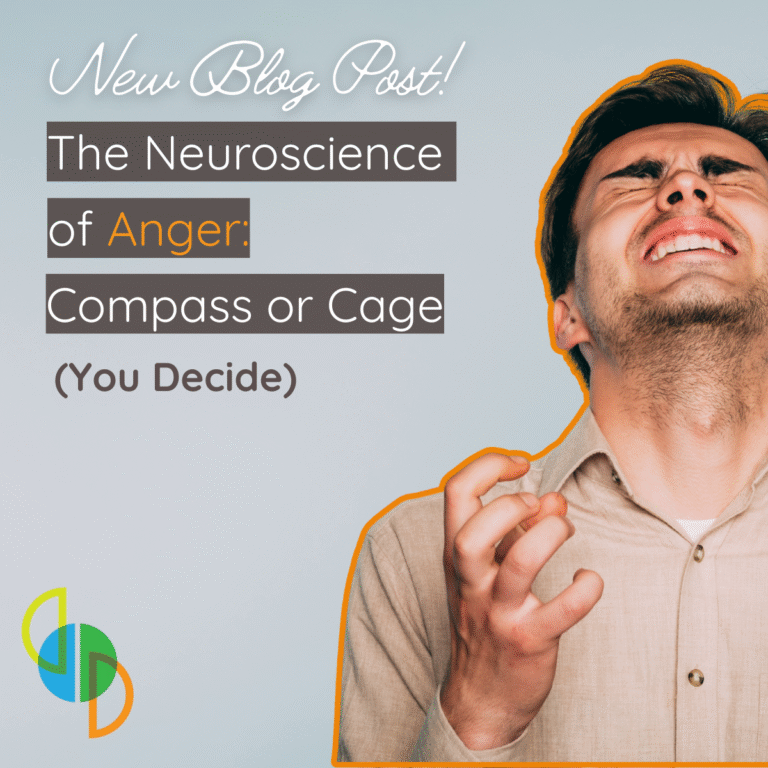
A compass or a cage … you decide.
It’s easy to think of anger as something that just happens to us, but every emotion we experience serves an evolutionary purpose—otherwise, it wouldn’t exist. Anger is no exception.
According to neuroscience, anger has a precise and important purpose. However, when that purpose is lost, anger can easily become misused and misunderstood, leading to negative patterns that can impair our judgment, clarity of mind, and emotional control.
But before we can understand how anger weakens the brain, it’s important to understand why we experience anger in the first place.
The Purpose of Anger
Emotions are not random or meaningless experiences that come and go without purpose. They are key evolutionary mechanisms; guideposts designed to help us navigate toward safety, connection, success, and ultimately, survival.
While we tend to resist negative emotions like anger, it serves just as much purpose as positive emotions like joy and contentment, including:
- Biological Purpose: Mobilization and Protection
The biological purpose of anger is to mobilize and protect. Anger activates the sympathetic nervous system, or the body’s fight-or-flight response. As a result, adrenaline surges, heart rate and blood pressure rise, and energy becomes instantly available to confront or correct a perceived threat.In evolutionary terms, anger helped our ancestors stand their ground rather than flee unnecessarily. In simple terms, anger is often the brain’s way of preparing the body to defend what matters.
- Psychological Purpose: Boundary Detection and Communication
Anger is also a messenger. It signals when something important, whether that be a value, need, or personal boundary, feels threatened. In this sense, anger communicates self-awareness and self-respect, alerting you to the need for change or action.When expressed constructively, anger helps clarify and communicate boundaries and personal values. - Motivational Purpose: Catalyst for Change
Anger can also serve as a motivation for change because it’s one of the few emotions that activate rather than shut down the nervous system. This activation creates energy, which can then be focused into action.In this way, anger can motivate problem-solving, social change, or assertive communication when channeled constructively.
When Anger Turns Harmful
Anger becomes destructive when it stops serving as a signal for awareness or purposeful action and instead turns into a default way of processing frustration or stress.
When anger is repeatedly activated without resolution, it stops being protective and starts being corrosive. Over time, this constant reactivity strains relationships, heightens emotional sensitivity, and even reshapes neural pathways in the brain. These patterns reinforce negative emotional loops, make calm harder to access, and reduce the clarity and reasoning we rely on when it matters most.
Here’s what happens inside the brain when anger takes over:
Anger Suppresses Your Logic and Reasoning
When anger arises, the amygdala (the brain’s emotional alarm system) triggers almost instantly, often before you’re even conscious of what’s happening. The amygdala signals the hypothalamus (the brain’s regulatory hub) to activate the fight-or-flight response: heart rate increases, muscles tense, and stress hormones flood the system.
At the same time, activity in the prefrontal cortex, the region responsible for reasoning, impulse regulation, and decision-making, is suppressed. With the brain’s reasoning and logic offline, emotional reactivity takes over. This is why people often say or do things they later regret in moments of anger: the brain literally shuts down reason, leaving reactivity in control.
In short, anger temporarily disables your “thinking brain” and hands control to your “emotional brain.”
Long-term Effects of Chronic Anger
When anger becomes frequent or prolonged, it keeps the brain in a state of hyperarousal or high alert mode. This chronic activation keeps stress hormones like cortisol elevated, which prevents the prefrontal cortex (logic and reasoning) from fully re-engaging and bringing you back to your senses.
Over time, this can lead to:
- Reduced focus and concentration as energy is diverted away from high-energy tasks like focus and learning in order to maintain hyperarousal.
- Impaired memory and decision-making as excessive cortisol shrinks the hippocampus, the memory and learning center.
- A shorter emotional fuse as anger pathways become more deeply embedded in the brain, and more easily activated.
- Less empathy and perspective-taking as logical and emotional centers disconnect.
In essence, chronic anger shrinks the space between trigger and response, leaving little room for reflection, reasoning, or self-control.
Anger Addiction
Surprisingly, anger can also create a neurochemical rush that feels rewarding in the moment. When you express anger, your brain releases a flood of dopamine. Dopamine is the same neurotransmitter involved in pleasure, reward, and addiction. This is why venting anger can feel like a satisfying release in the moment, even though you may regret your words or actions later.
But here’s the trap: The dopamine spike reinforces the anger reaction, training your brain to seek that chemical payoff again.
Over time, this creates a destructive loop: stress → anger → release → dopamine spike -> brief relief/satisfaction → stress comes flooding back in.
Because of dopamine’s role, anger can feel good momentarily and drive the brain to seek that same relief again in the future. Over time, this reinforces the reactive neural network, causing the brain to rely on anger more often as a quick source of relief, while becoming increasingly sensitive and reactive in the process.
Cereset and Anger
Anger is meant to be temporary… a guidepost for direction, not a permanent state.
When anger strays from its purpose, it gradually takes control of the nervous system, shaping our thoughts, reactions, and even our physiology. Over time, the brain becomes conditioned to respond from a place of reactivity rather than discernment, meaning we stop consciously choosing our responses and start automatically reacting.
In this state, anger is no longer a signal that guides us; it’s a force that controls us, leaving us passengers on a chaotic ride of emotions and reactivity.
Cereset uses advanced neurotechnology to help the brain recognize and release stuck patterns, including those formed by chronic anger, stress, trauma, or emotional overload.
During a Cereset session, the brain’s rhythms are reflected back to it in real time through acoustic tones. This “mirror effect” helps the brain see itself and naturally move toward a more regulated state.
Through this process, Cereset helps:
- Restore communication between emotional and cognitive brain regions
- Calm overactivation in stress-affected areas
- Rebalance the autonomic nervous system
- Support deep relaxation and healthier emotional regulation
- Release stuck patterns that are no longer serving you
- Support clarity, focus, and peace of mind
When the brain no longer feels trapped in survival mode, it doesn’t need anger to feel safe. It can respond instead of react.
Remember, anger is a message intended to guide us, protect us, and inspire action, but when we lose sight of anger’s true purpose, we lose clarity, control, and calm.
By helping the brain restore balance, Cereset helps us reclaim what we have lost.
by Sonya Crittenden,
Director of Client Services & Education
Cereset Corporate Headquarters
FIND THE CERESET CLIENT CENTER NEAREST YOU & CALL TODAY
*Cereset is not a medical provider and does not diagnose, treat, cure, or prevent concussions or any other medical condition. Any serious head injury or concussion with severe or worsening symptoms should be evaluated immediately by a licensed medical professional.
_