
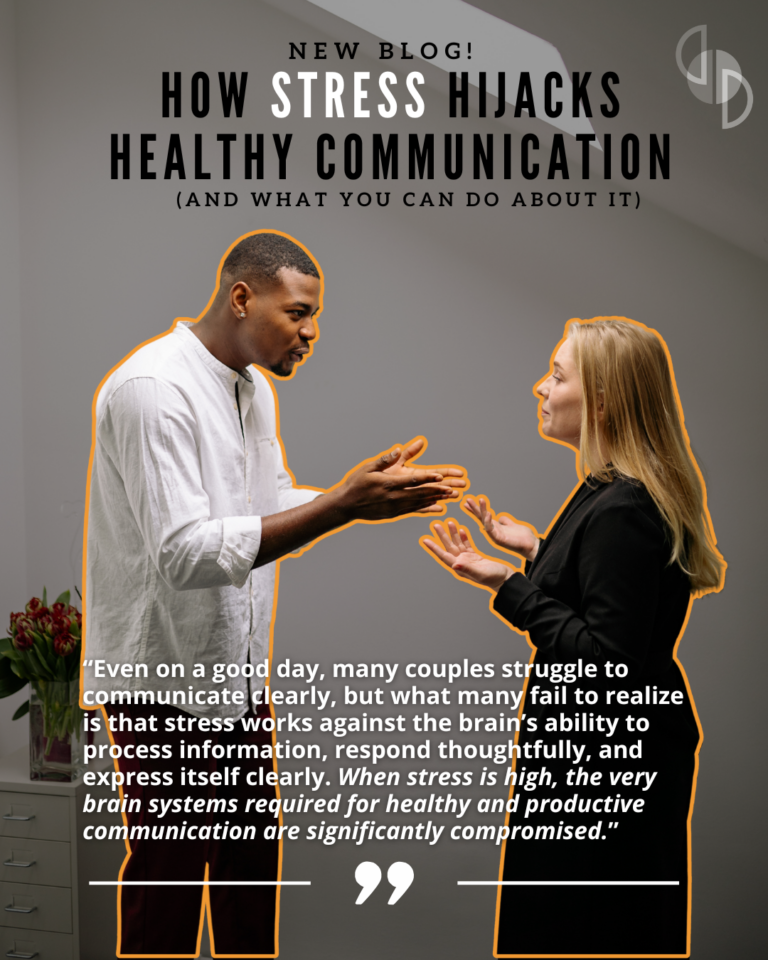
How Stress Hijacks Healthy Communication
… and What You Can Do About It
Valentine’s Day is just around the corner, and it’s a time of year when we celebrate the relationships that matter most to us. But amid the flowers, chocolates, and romance, it can also serve as a reminder that relationships of all types can be challenging, especially when it comes to communication.
Even on a good day, many couples struggle to communicate clearly, but what many fail to realize is that stress works against the brain’s ability to process information, respond thoughtfully, and express itself clearly. When stress is high, the very brain systems required for healthy and productive communication are significantly compromised.
In short, stress actively suppresses the functions needed for calm, rational, and productive conversation, yet most of us don’t account for this when conflict arises. In this blog, we’ll explore how stress directly impairs communication at a neurological level, and how small shifts in awareness and approach can help bring calm, clarity, and connection back into your interactions with the people you care about most.
What Happens in the Brain During Stressful Interactions
When your brain perceives a threat, whether it’s a raised voice, a sharp tone, or even a painful memory, the amygdala sounds the alarm. This activates the stress response, triggering a cascade of physiological changes that prepares the body for fight, flight, or freeze.
While this response is essential for survival when in real danger, it can be deeply disruptive during emotional conflict or heated discussions. Here’s why:
- The brain doesn’t distinguish between physical danger and emotional or psychological stress. To the nervous system, all stress is the same and triggers a similar survival response, whether you’re escaping a real threat or navigating a heated conversation. As a result, emotional or mental distress can easily be misinterpreted by the brain as danger, causing us to overreact and unintentionally escalate conflict.
- Stress and strong emotions like anger, frustration, or overwhelm suppress the prefrontal cortex, the part of the brain responsible for logic, reasoning, empathy, impulse control, and perspective-taking. In other words, when stress or emotions run high, your “thinking brain” goes offline, making you more likely to say things you don’t mean or act in ways that don’t reflect your true intentions.
- At the same time, the limbic system (the emotional brain) takes over, flooding the body with stress hormones like adrenaline and cortisol. This shifts the brain’s focus toward reaction, protection, and defense – not communication. This makes you more sensitive and reactive in ways that directly undermine healthy, productive conversation.
In this state, the brain’s priority shifts from connection, communication, and mutual understanding to survival.
The result?
Both parties’ ability to listen, reason, process information effectively, and communicate clearly is biologically limited. No one is consciously choosing to be difficult; the nervous system has simply taken over.
Signs the Brain’s Stress Response Is Triggered
Recognizing the signs that a stress response has taken over and that the brain is no longer prioritizing healthy communication can prevent a minor disagreement from escalating into a major breakdown. Rather than pushing an interaction that’s rapidly unraveling, we can take intentional steps to de-escalate, restore a sense of safety, and give the nervous system the time it needs for communication and clarity to come back online.
But it all starts with identifying the signs. Common indicators that a stress response has been triggered and is hindering productive communication include:
- A noticeable shift in tone of voice (louder, sharper, or more defensive).
- Faster, shallower breathing or visible tension in the jaw, neck, or shoulders.
- Protective body language, such as crossed arms, clenched fists, rigid posture, or increased physical distance.
- Dilated pupils or a “blank” or frozen stare (fight or freeze responses).
- Interrupting, repeating the same points, or difficulty finding words.
- Sudden withdrawal or shutting down (mind goes blank or numb).
- Your thoughts are racing, but you can’t find the words to express yourself.
These are all signs that the brain is no longer in a collaborative mode; it’s in self-protection mode. Once this state is activated, you can’t “talk your way out of it,” because the brain isn’t truly listening.
How to Reset Communication During Conflict
If you notice these signs, the most effective move isn’t to push harder or insist the conversation continue; it’s to pause and help the nervous system return to safety.
Here’s how:
- Lower the emotional temperature. Speak calmly, soften your tone, and reduce physical intensity. Notice your own body language and relax it (uncross your arms, unclench your jaw, and allow space).
- Name your emotion. “Affect labeling,” or putting words to what you’re feeling, helps reengage the prefrontal cortex, the part of the brain responsible for reasoning, logic, and regulation. As the prefrontal cortex comes back online, activity in the amygdala (the brain’s fear and alarm center) decreases. Neuroscientist Dr. Matthew Lieberman refers to this as the “name it to tame it” effect. By saying things like “I feel hurt” or “I feel frustrated,” you help shift your brain out of reactive mode and back into thinking mode.
- “Ride the wave” of emotion. According to Dr. Jill Bolte Taylor, the initial chemical response that creates an emotion lasts about 90 seconds. After that, if you’re still feeling angry, anxious, or upset, it’s not because the original emotion is continuing; it’s because your thoughts are replaying the event and re-triggering the chemical response. To regain control, Dr. Bolte Taylor recommends riding the wave for those 90 seconds without reacting. Pause. Breathe. Resist the urge to respond or act. Avoid feeding the emotion by replaying the story or making assumptions about intent (for example, “She said that to hurt me on purpose”). When you allow the wave to pass without reactivating it, you strengthen your ability to regulate emotions rather than letting them control you.
- Don’t make major decisions in the heat of the moment. Emotional discomfort can drive impulsive choices in an effort to find quick relief, but decisions made under high stress are often misaligned with long-term well-being and frequently regretted later. When possible, pause the decision for at least 24 hours to allow emotions to settle and clarity to return.
- Take a break. Suggest a pause: “Let’s take a breather. I want to have this conversation when we can really hear each other.”
- Regulate yourself first. Research shows that stress is contagious, and simply observing someone who is upset can activate your own nervous system. The good news is that regulation is contagious, too. When you slow your breathing, relax your body, and stay grounded, you create cues of safety that help the other person’s nervous system settle as well.
- Reconnect before reasoning. Gentle empathy, validation, humor, or reassurance often restores a sense of safety faster than words or explanations.
- Return to the conversation later. Once both parties are regulated, the brain is far more capable of listening, understanding, and responding thoughtfully.
- Sleep on it (literally). Sleep, especially REM sleep, plays a major role in emotional processing. Many studies show that emotional reactivity to a stressful event is significantly reduced after one night of sleep. This is why the “sleep on it” suggestion is so effective and neurologically sound.
- Consider Cereset to help rebalance an overactivated nervous system. When the nervous system is chronically overactivated and reactive, even the best intentions can be overridden, making healthy communication difficult if not impossible. If your reactions often feel out of your control and it feels like your nervous system is running the show, your brain may need support in resetting stress patterns. In these cases, Cereset can help the nervous system settle, creating conditions for calmer responses and more effective communication.
The Takeaway
When the brain’s stress response takes over, effective communication isn’t just emotionally challenging, it’s neurologically compromised.
In these moments, the parts of the brain responsible for listening, reasoning, empathy, and perspective-taking are temporarily offline. Understanding this allows us to approach conflict with intention and clarity rather than with reactivity.
Effective communication isn’t about winning an argument. It’s about helping both people feel safe enough, physically and emotionally, to slow down, listen, and respond thoughtfully.
When a sense of safety is restored, the nervous system settles.
When the nervous system settles, clarity returns.
And that’s when true understanding and real connection can begin again.
by Sonya Crittenden,
Director of Client Services & Education
Cereset Corporate Headquarters
FIND THE CERESET CLIENT CENTER NEAREST YOU & CALL TODAY
*Cereset is not a medical provider and does not diagnose, treat, cure, or prevent concussions or any other medical condition. Any serious head injury or concussion with severe or worsening symptoms should be evaluated immediately by a licensed medical professional.