
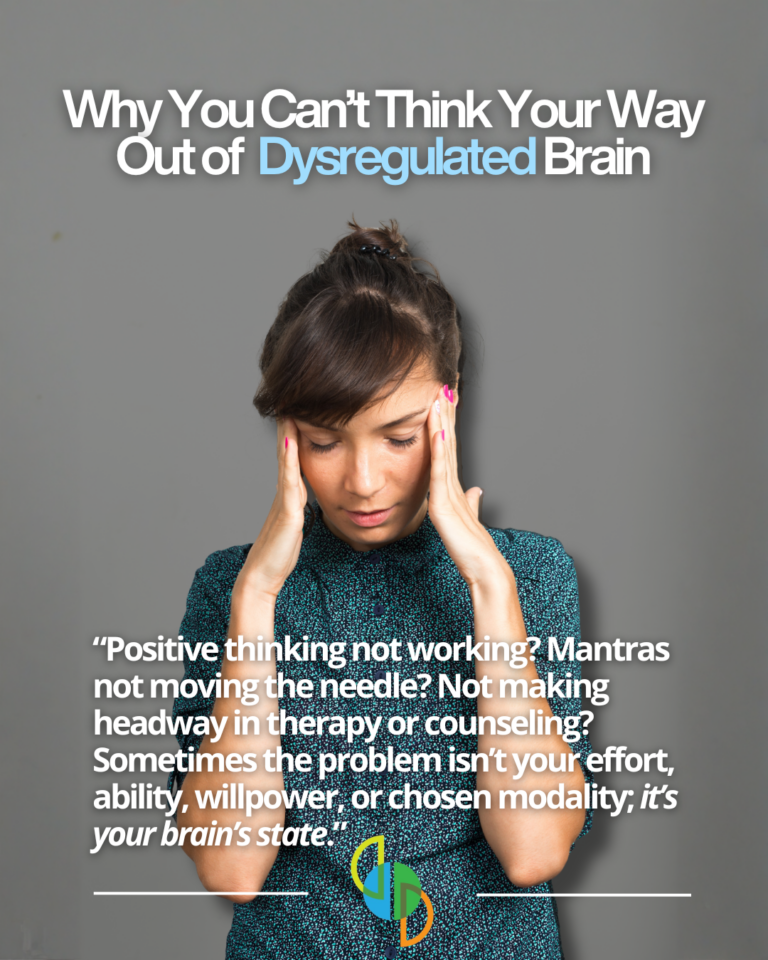
Positive thinking not working?
Mantras not moving the needle?
Not making headway in therapy or counseling?
If you’ve ever tried to think your way out of stress, anxiety, or emotional overwhelm, you’re not alone.
Maybe you’ve tried repeating positive affirmations.
Maybe you’ve focused on prioritizing positive thoughts or reframing.
Maybe you’ve worked hard in therapy.
Maybe you’ve read the books, listened to the podcasts, and practiced the strategies.
And yet… something still feels stuck. Despite your best efforts, the change you hoped for just doesn’t seem to be happening.
When that happens, many people assume they’re doing something wrong. They wonder if they just aren’t trying hard enough, thinking positively enough, or applying what they’ve learned well enough.
But here’s something important to understand:
Sometimes the problem isn’t your effort, ability, willpower, or even your chosen modality; it’s your brain’s state!
When the brain is dysregulated from stress, it can become incredibly difficult to think, process, and respond in ways that move you forward. This is not a moral failing; it’s neuroscience in action.
In these moments, trying to “think your way out of it” can feel almost impossible, and not because you lack insight or motivation, but because your brain is operating in survival mode … let’s explore why.
WHEN STRESS SHUTS DOWN THE PREFRONTAL CORTEX
The prefrontal cortex (PFC) is the part of the brain responsible for many of the abilities we rely on for personal growth and development:
- Rational thinking
- Emotional regulation
- Decision-making
- Self-reflection
- Problem solving
- Perspective-taking
- Impulse control
In short, the prefrontal cortex is what helps us pause, reflect, and choose a thoughtful response rather than react impulsively, defensively, or irrationally.
But here’s the key: stress changes how the brain functions, including how it processes information and responds to the world around us.
When the brain perceives threat, whether that stress is physical, psychological, or even imagined, it shifts important resources away from the prefrontal cortex and toward more primitive survival circuits in the brain. This, in turn, suppresses activity in the prefrontal cortex, making it harder to think clearly, plan ahead, and make good decisions.
This response is designed to protect us. When danger is present, the brain prioritizes speed and power over reflection and insight. So instead of thinking carefully, the brain moves toward fight, flight, or freeze stress responses to protect you.
The problem is that modern stress rarely resolves quickly. Think work deadlines, relationship conflicts, financial worries, performance pressure, information overload… Instead of escaping a predator and returning to calm when the threat passes, many people live in a nearly constant state of low-grade threat.
When this happens, the prefrontal cortex can remain under-engaged for long periods of time. As a result, strategies that rely on higher-level thinking, such as reframing thoughts, applying coping strategies, engaging in self-reflection, challenging limiting perspectives, and participating in thoughtful discussion, can become much harder to access.
YOUR BRAIN PROCESSES STRESS BEFORE YOU’RE EVEN AWARE OF IT
Another reason it can be so difficult to think your way out of dysregulation is that stress responses begin before conscious awareness.
The brain is constantly scanning the environment for signs of threat through a process called neuroception, which occurs below the level of conscious thought.
Signals from the body and sensory systems are rapidly evaluated by deeper brain structures such as the amygdala and brainstem. These systems quickly assess whether something feels safe, uncertain, or threatening, often within milliseconds.
If the brain detects a potential threat, the stress response begins before the prefrontal cortex has time to logically evaluate the situation. This means that by the time you consciously notice that you feel anxious, reactive, or shut down, your nervous system may have already shifted into a survival state.
In fact, the brain’s threat-detection systems can react 3–10 times faster than conscious awareness, meaning your body often responds to stress before your thinking mind even has a chance to weigh in.
That’s why people sometimes say things like:
“I know logically this isn’t a big deal, but I still feel very upset.”
“I know the thought isn’t rational, but I can’t stop thinking it.”
“I understand what I should do, but I can’t seem to do it.”
These experiences aren’t failures of willpower; they are examples of biology moving faster than cognition.
WHEN DYSREGULATION CAN SLOW DOWN PERSONAL GROWTH
Therapy, counseling, personal coaching, and personal development strategies rely heavily on the brain’s ability to:
- Listen and absorb new information or perspectives
- Reflect on patterns and behaviors
- Engage in thoughtful discourse
- Challenge existing beliefs that are no longer serving you
- Identify and process emotions
- Apply new strategies outside of sessions
But when the nervous system is stuck in survival states, these capabilities can become limited and suppressed.
If your brain is stuck in fight-or-flight state, you may feel:
- Reactive
- Hyper-alert
- Hypersensitive
- Easily triggered
- Emotionally flooded or overwhelmed
- Racing thoughts or rumination
In this state, it can be difficult to fully listen, absorb, and process what’s being shared in therapy or counseling simply because the brain is too focused on scanning for threats and preparing to react.
In short, even helpful insights can be hard to integrate because the nervous system isn’t primed to listen and receive; it’s ready to fight or flee.
On the other hand, if your brain is stuck in a freeze state, you might experience a very different response, including:
- Emotional numbness or disconnect
- Low motivation
- Brain fog/ lack of clarity and insight
- Difficulty initiating action
- Feeling overwhelmed, stuck, or shut down
When stuck in a freeze state, people may intellectually understand what they learned in therapy, but struggle to act on it or apply it in daily life. It’s not that the information isn’t valuable, it’s that the brain’s current state makes taking action incredibly difficult.
As the term freeze state suggests, the brain isn’t prioritizing growth or forward movement; it’s prioritizing safety through immobilization.
In short, when the brain is dysregulated, it can make it much harder to benefit from supportive and growth-oriented activities like therapy, counseling, or coaching, but this isn’t a failure of effort or commitment; it’s simply your brain’s attempt to protect you.
WHEN THE BRAIN IS REGULATED, EVERYTHING BECOMES EASIER
This is why regulating the brain’s stress response can be such an important foundation for growth. When the brain feels safe, it can shift out of stuck survival states that limit its natural functioning. Regulation creates safety, and safety allows the brain to release chronic stress patterns and return to more flexible, effective performance.
When the nervous system is calmer and more flexible:
- The prefrontal cortex can engage more easily
- Emotional processing becomes more efficient and effective
- New insights are easier to integrate
- Meaningful behavior change becomes more accessible
In other words, the brain becomes more capable of using the tools that therapy, counseling, and coaching provide.
CERESET AS A COMPLEMENT TO THERAPY AND COUNSELING
It’s important to be clear: Cereset is not a replacement for therapy or counseling.
In fact, we are strong supporters of anything that helps people receive support, insight, and healing.
Therapy can provide invaluable benefits, including guidance, emotional processing, relationship repair, a deeper understanding of personal patterns, support, and accountability, but sometimes people find themselves feeling stuck despite doing meaningful work.
When that happens, it may not be about trying harder; it’s about helping the brain shift out of chronic stress patterns so it can fully engage with the work being done.
Cereset is designed to support the brain in recognizing and releasing stress patterns, allowing the nervous system to settle and reorganize. As the brain becomes more regulated, many people find that the strategies they’ve been learning in therapy or counseling become easier to apply, and the insights they’ve gained are more easily translated into meaningful action.
In this way, Cereset can act as a powerful complement, helping individuals get the most out of the insights and tools they’re already working hard to develop.
SOMETIMES IT’S NOT ABOUT TRYING HARDER
If you’ve been putting in the effort, like thinking positively, practicing coping strategies, showing up to therapy, and still feel stuck, it’s worth remembering:
You’re not broken.
You’re not failing.
And neither is your therapist.
Sometimes the brain simply needs help shifting out of survival mode before it can fully access the skills and insights that lead to lasting change.
When the brain’s state changes, everything else can start to move forward again.
by Sonya Crittenden,
Director of Client Services & Education
Cereset Corporate Headquarters
FIND THE CERESET CLIENT CENTER NEAREST YOU & CALL TODAY
*Cereset is not a medical provider and does not diagnose, treat, cure, or prevent concussions or any other medical condition. Any serious head injury or concussion with severe or worsening symptoms should be evaluated immediately by a licensed medical professional.