… And What We Can Do About It
Have you ever made a quick judgment, jumped to a wrong conclusion, or even stuck to a belief despite evidence to the contrary? These are all instances of cognitive biases at work.
Cognitive biases are mental shortcuts, or heuristics, that help us make sense of a complex world. While they can be useful when making quick decisions, they can easily lead to distorted thinking, flawed judgments, and missed opportunities if not challenged.
But if cognitive biases can lead us to wrong assumptions or misperceptions, why do we have them in the first place? It all goes back to how the brain functions and processes information.
One of the brain’s main priorities is to process information as quickly and efficiently as possible, while conserving valuable (and limited) energy resources. To conserve energy and increase processing speed, the brain uses mental shortcuts, including:
- Ignoring new or unexplored information or perspectives.
- Reusing highly established neural networks for processing information (i.e., the brain reinforces already established beliefs and perceptions and filters new information through this lens).
- Oversimplifying complex or large amounts of information.
- Processing information based on past experiences or emotions, rather than the current context.
While cognitive biases help the brain process large amounts of information quickly, they often lack broader consideration and context that could provide a more accurate or realistic understanding.
Cognitive biases are most likely to occur when:
- You need to make a decision quickly and are under pressure (the brain lacks the time to consider other alternatives or additional information).
- There is information overload (the brain gets overwhelmed or lacks the energy required to process large amounts of data).
- A situation or scenario has strong links to past emotional events or experiences (our emotions prevent us from logically and objectively considering the information).
- There’s a highly complex problem or situation (the brain automatically simplifies the situation or problem to make it more manageable).
Because cognitive biases are hardwired into the brain, all of this happens behind the scenes without our conscious knowledge or awareness. This is why cognitive biases can be so difficult to recognize and control.
While cognitive biases may seem harmless, they can have significant and long-lasting effects on your life, including:
- leading to distorted or misinformed decision-making.
- limiting opportunities for new experiences or relationships.
- limiting self-awareness and personal growth.
- damaging relationships.
- limiting creativity, innovation, and exploration.
- exacerbating mental health issues like anxiety and depression.
The first step to rectifying the negative influence of cognitive biases is to recognize how and when they often manifest in our lives.
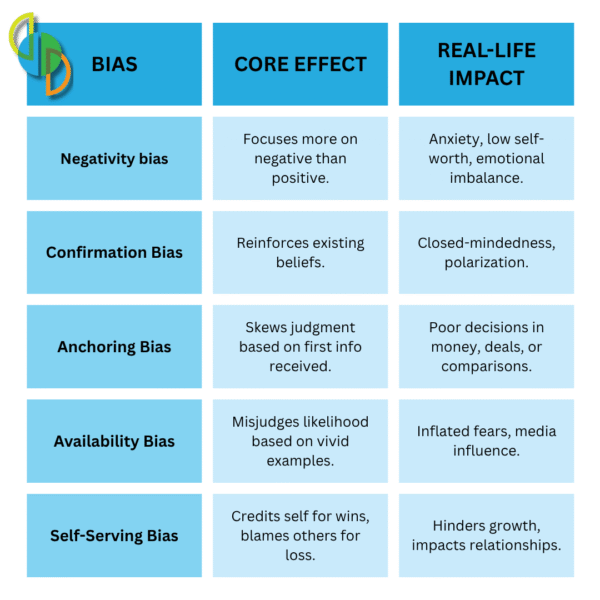
Here are 5 of the most common cognitive biases, and what you can do to avoid falling for them:
1. Negativity Bias
“I pay more attention to the negative than the good.”
The negativity bias is when we tend to give more weight and attention to negative experiences or information than positive ones. This bias is deeply rooted in the brain because it stems directly from the brain’s survival instinct – after all, you are more likely to survive if you anticipate danger and prepare for worst-case scenarios. As a result, the brain is hardwired to look for and anticipate the negative.
How do I know if I’m falling for the negativity bias?
You may be falling victim to the negativity bias if:
- You tend to remember one rude or negative comment while dismissing the positive feedback or compliments you receive.
- You fixate on your mistakes and failures while overlooking your successes and growth.
- You assume danger or failure even when things are going well.
What to do to avoid falling for the negativity bias:
Intentionally focus on the positive by keeping a daily gratitude journal or practicing the “3 wins” exercise (reflecting on and writing down 3 meaningful “wins” from your day, no matter how big or small).
2. Confirmation Bias
“I only accept information that confirms what I already believe.”
Confirmation bias is when we tend to seek out, interpret, and remember information that confirms our existing beliefs while ignoring any information that contradicts them. This includes only reading news that aligns with your opinion or viewpoint and dismissing criticism or counterevidence.
How do I know if I’m falling for the confirmation bias?
Ask yourself, “What information would change my belief or opinion?” If your answer is, “nothing can change my belief or opinion”, then you are likely experiencing confirmation bias.
What to do to avoid falling for the confirmation bias:
- Actively challenge your views. This encourages neural flexibility and adaptability. Ask yourself: “What would I think if I believed the opposite?”
You don’t have to change your beliefs, but you should be able to objectively consider relevant information without getting defensive or feeling threatened.
3. Anchoring Bias
“I can’t help but focus on the first piece of information I heard.”
The anchoring bias occurs when we focus on the first piece of information we receive (even if arbitrary), which heavily influences later judgments. This happens because the first piece of information establishes the brain’s foundation from which the brain processes subsequent information.
Unfortunately, just because we heard it first does not mean it’s accurate.
How do I know if I’m falling for the anchoring bias?
You may be falling for the negativity bias if:
- You tend to judge new people based on first impressions.
- New information is ignored or dismissed.
- You hold on to early advice, even when better info is available.
What to do to avoid falling for the anchoring bias:
Pause. Consider multiple perspectives or data points before making a decision.
4. Availability Bias
“If I can think of it easily, it must be true or likely.”
The availability bias occurs when we judge the probability of events based on how easily examples come to mind, rather than on actual data.
This means that information that is exciting, surprising, or unusual (which is easier to recall than boring or mundane details) is more likely to influence our beliefs and perceptions. This is how conspiracy theories can quickly gain traction, because their memorability makes the brain assign high value to them.
How do I know if I’m falling for the availability bias?
You may be falling victim to the anchoring bias if one or two recent events suddenly represent a “trend” or pattern, or you tend to overestimate rare events and underestimate common risks.
What to do to avoid falling for the availability bias:
Look at all of the evidence. Seek actual statistics or broader context before making assumptions.
5. Self-Serving Bias
“If I succeed, it’s because of me. If I fail, it’s because of something else.”
The self-serving bias occurs when we tend to attribute success to our own abilities and failures to external factors.
How do I know if I’m falling for the self-serving bias?
You may be falling for self-serving bias if you:
- Tend to take credit for good outcomes but blame others for failures.
- Resist learning from constructive feedback or your own mistakes.
- Tend to deflect responsibility in relationships or teams.
How to avoid falling for the self-serving bias:
Practice honest self-reflection and embrace opportunities to learn and grow.
Because cognitive biases are hardwired into the brain, we cannot eliminate them completely; however, we can learn to recognize them and make different choices by:
- Slowing down. Give yourself a moment to take a step back and really consider the information. Cognitive biases thrive when time is limited, so slow down the clock.
- Asking for feedback. Other people can often see our blind spots more clearly than we can.
- Exposing yourself to diverse perspectives. Read outside your echo chamber. Seek respectful conversations that challenge you. The goal is not to change your beliefs, but to develop mental flexibility, where you can consider other perspectives without feeling threatened, upset, or a loss of identity.
- Practicing metacognition. That’s just a fancy word for “thinking about your thinking.” Regularly check your thought patterns, like a tendency to focus on the negative.
- Using data, not just intuition. When possible, base your decisions on facts, not feelings or assumptions.
Cognitive biases are part of being human. We have all been influenced by cognitive biases at some point, whether we like to admit it or not.
When we allow these biases to go unchecked, they can cloud judgment, distort perceptions, and lock us into unhelpful patterns of thinking.
The good news? Your brain is not in a fixed state.
With the right support, it can regain balance, clarity, and flexibility. Cereset helps your brain reset itself naturally, quieting stress-driven patterns and restoring harmony between regions that influence thought, emotion, and decision-making. When your brain is better regulated, you can step out of survival mode, see situations more clearly, and make decisions based on reason rather than reactive bias.
In short, a balanced brain is a clearer, more objective brain, and that’s a powerful advantage in life.
by Sonya Crittenden,
Director of Client Services & Education
Cereset Corporate Headquarters