
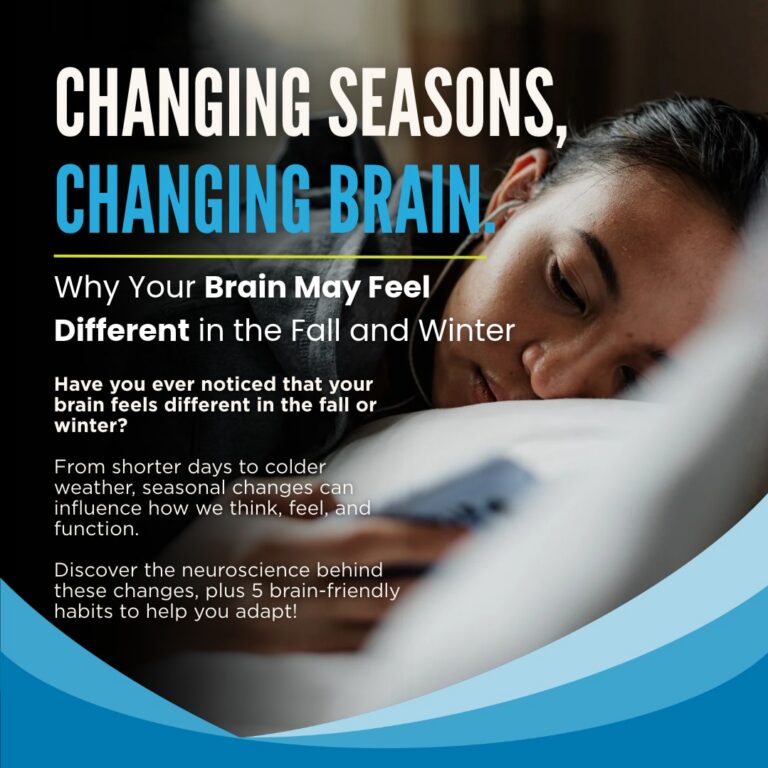
Have you ever noticed that your brain feels different in the fall?
If so, it might not be just your imagination.
In fact, research shows us that seasonal transitions, like shorter days and colder weather, can also bring some unexpected changes in how we think and feel.
For some people, autumn marks the beginning of a noticeable shift in energy, mood, sleep, and motivation. You may find yourself feeling more sluggish than usual, struggling to concentrate, experiencing disruptions in your typical sleep patterns, or dealing with increased fatigue. You might even notice a shift in your emotional well-being, such as feeling more irritable, unmotivated, or down than usual, without an obvious reason for why.
We may often assume these changes are purely coincidence or random, but science suggests that seasonal changes in our environment, including shifts in daylight exposure, temperature, and daily routines, can influence the biological processes that play a role in regulating brain function. As a result, seasonal changes can affect everything from our sleep patterns to our mood, motivation, and cognitive performance.
In other words, seasonal shifts don’t just affect our external environment, they can also influence what’s happening inside of us. In this blog, we will explore the fascinating neuroscience behind these seasonal shifts and what you can do to better support your brain through these changes.
Changing Seasons and Your Internal Clock
Your brain has an internal biological timing system that generates circadian rhythms, which help regulate everything from your sleep-wake cycle and energy levels to digestion, metabolism, and hormone release.
These rhythms operate on approximately 24-hour cycles, helping coordinate when we feel alert and energized, when our bodies are primed for eating and digestion, and when we begin to feel drowsy and ready for sleep. In this way, our circadian timing system plays a fundamental role in organizing and synchronizing many of our body’s essential physiological processes.
But here’s the key: Your brain’s internal clock is also closely connected to the changing seasons.
At the center of this intricate timing system is a small but powerful region of the brain called the hypothalamus, which plays a crucial role in maintaining homeostasis (the body’s ability to maintain a relatively stable internal environment despite changing internal and external conditions). To maintain homeostasis, the hypothalamus integrates information about the body’s internal state and responds to signals from the surrounding environment, helping coordinate adjustments in essential functions such as body temperature, hunger, thirst, hormone regulation, and sleep.
Within the hypothalamus lies the suprachiasmatic nucleus (SCN), a specialized group of neurons that serves as the brain’s primary circadian pacemaker, often referred to as our master biological clock. The SCN helps coordinate the timing of numerous biological processes, ensuring that our internal rhythms remain synchronized with one another and with our external environment. Interestingly, one of the most powerful environmental signals guiding the brain’s internal clock is natural light.
Our circadian timing system relies on environmental cues, particularly the daily cycle of light and darkness, to keep our internal biological rhythms aligned with the outside world. In fact, specialized light-sensitive cells in the retina of our eyes communicate information about environmental light directly to the brain’s master clock.
This connection allows the SCN to detect changes in environmental light and coordinates the timing of important physiological processes, like the regulation of melatonin. Melatonin is an important hormone that signals nighttime to the brain and supports healthy sleep-wake rhythms. As light fades and darkness falls, melatonin levels typically begin to rise, signaling to the brain and body that nighttime is approaching and preparing us for sleep. Conversely, as the brain detects morning light, melatonin production is suppressed, supporting our transition toward wakefulness and daytime alertness.
In essence, melatonin serves as a biological signal for nighttime, while natural light helps keep our internal clock synchronized with the external 24-hour cycle of light and darkness. Together, these processes help our brain and body coordinate when to prepare for rest and when to become more alert, active, and energized.
But as fall and winter arrive, the timing, duration, and intensity of natural daylight begins to change. In many regions, the sun rises later and sets earlier, bringing shorter days, longer nights, and cooler temperatures.
These seasonal changes can also influence our daily habits. As temperatures drop and daylight hours become more limited, we may find ourselves spending more time indoors, which further reduces our exposure to natural light.
Because natural light is one of the primary environmental signals that helps synchronize our internal biological clock, changes in light exposure can influence our circadian rhythms, potentially altering the timing of melatonin release and disrupting our normal sleep-wake patterns. This can create a domino effect, potentially contributing to:
- Increased fatigue or daytime drowsiness, even when it seems like we are getting adequate sleep.
- Changes in our usual sleep patterns, including feeling sleepy earlier or difficulty waking in the morning.
- Reduced concentration and mental clarity, making it harder to stay focused, attentive, or mentally energized.
- Changes in mood and motivation, including feeling less enthusiastic, more irritable, or mentally sluggish.
- Fluctuations in energy levels, particularly during periods of reduced daylight exposure.
The bottom line? That extra fatigue, reduced motivation, or mental sluggishness you experience during the fall or winter seasons may not simply be your imagination. It could, at least in part, reflect your brain and body’s natural response to changing environmental light conditions and the adjustments required to keep your internal biological rhythms synchronized with the outside world.
This highlights an important principle of brain health: Our ability to adapt to changing conditions is just as important as our ability to maintain internal stability.
Changing Seasons and Neurochemistry
Changes in daylight exposure and seasonal routines don’t just influence our circadian rhythms and internal biological clock. Research suggests that seasonal changes may also influence certain neurotransmitter systems, which use chemical messengers to help regulate important functions like mood, motivation, attention, and emotional well-being.
Two neurotransmitter systems that appear to be particularly responsive to seasonal changes are serotonin and dopamine.
Serotonin is commonly referred to as the brain’s “feel-good neurotransmitter,” although its functions are far more wide-ranging. It plays an important role in mood regulation, emotional processing, sleep, and numerous other physiological processes. Serotonin signaling is also a common target of antidepressant medications, including selective serotonin reuptake inhibitors (SSRIs) and serotonin-norepinephrine reuptake inhibitors (SNRIs).
Interestingly, research has identified some associations between seasonal sunlight exposure and certain aspects of serotonin activity.
For example, a study published in The Lancet examined markers of serotonin turnover in 101 healthy men. Serotonin turnover is the rate at which the brain synthesizes, reabsorbs, and breaks down serotonin, which can give us a potential indication of how well the system is utilizing serotonin. The study found that serotonin turnover was lowest during the winter months. Researchers also observed a positive association between bright sunlight exposure and serotonin turnover, suggesting that environmental light may influence certain aspects of the brain’s serotonin signaling system.
Other studies have identified seasonal variations in serotonin transporter availability, with some observing higher levels during the fall and winter compared with the spring and summer months. Serotonin transporters play an important role in regulating serotonin signaling by removing serotonin from the space between nerve cells and transporting it back into the releasing neuron. Changes in serotonin transporter availability may therefore influence how serotonin signals are regulated in the brain. However, higher transporter availability does not necessarily mean that an individual has lower overall serotonin levels.
Researchers have proposed that these seasonal differences may be one factor contributing to changes in mood and emotional well-being, particularly among individuals who are more sensitive to seasonal variations in daylight.
While serotonin has received considerable attention in seasonal mood research, emerging evidence suggests that environmental light exposure and seasonal conditions may also influence certain aspects of dopamine signaling, another neurotransmitter that plays a role in motivation, reward processing, attention, learning, and goal-directed behavior.
A recent 2024 study investigating seasonal variations in dopamine signaling identified associations between daylight duration and dopamine D2/D3 receptor availability in specific brain regions. Interestingly, researchers observed higher dopamine D2/D3 receptor availability during periods of shorter daylight.
One possible explanation for this finding involves changes in baseline dopamine levels. When less dopamine is present, fewer receptors may be occupied by the neurotransmitter, potentially resulting in higher measured receptor availability on PET imaging. In other words, greater receptor availability may, in some circumstances, reflect lower dopamine activity rather than increased dopamine signaling.
While these findings offer another intriguing connection between seasonal conditions and brain function, neurotransmitter regulation is highly complex and influenced by numerous factors beyond daylight exposure. Nevertheless, this research adds to a growing body of evidence suggesting that seasonal environmental changes may be associated with shifts in the brain’s neurochemical activity, potentially contributing to variations in mood, motivation, and cognitive functioning.
The Rhythm of Routine
Beyond potential changes in neurotransmitter activity, the arrival of colder weather and shorter days can also greatly influence our everyday behaviors and routines, which can have meaningful consequences for our wellbeing and brain health.
As the weather becomes colder, darker, and wetter, we may naturally spend less time outdoors, participate in fewer physical outdoor activities, or experience disruptions to routines that ordinarily support our mood, motivation, and social connections.
Activities such as physical exercise, meaningful social interaction, and spending time in nature are all known to positively influence emotional well-being while engaging the brain’s reward and stress-regulation systems. However, when these activities become less frequent, we may lose some of the regular opportunities that help us feel energized, motivated, socially connected, and emotionally balanced.
When these behavioral changes occur alongside shifts in daylight exposure and circadian timing, their effects may feel compounded.
The important thing to understand is that seasonal changes can influence both the biological processes that regulate brain function and the everyday activities that support our well-being, potentially creating a domino effect across our sleep, energy, mood, motivation, and cognitive performance.
Seasonal Affective Disorder
Considering the many ways that seasonal changes can impact the brain, our routines, and behavior, it’s not surprising that some may experience these transitions quite profoundly.
One condition closely associated with seasonal changes is Seasonal Affective Disorder (SAD), commonly used to describe a recurring pattern of depressive episodes that typically begin during the fall or winter months and improve during the spring or summer.
SAD is estimated to affect approximately 5% of U.S. adults, although prevalence estimates vary depending on geographic location, diagnostic criteria, and the population studied. Some research suggests that winter-pattern seasonal depression may be more common at higher latitudes, where seasonal changes in daylight are more extreme and winter days are significantly shorter.
The underlying causes of SAD are complex and not yet fully understood, however, researchers believe that changes in daylight exposure, circadian timing, and neurotransmitter signaling may contribute to its development, particularly in individuals who are already biologically or physiologically vulnerable.
Why Are Some People More Sensitive to Seasonal Changes?
While seasonal mood and behavior changes are prominent enough to warrant ongoing research, not everyone experiences seasonal transitions in the same way.
But why not?
Some individuals may barely notice the changing daylight hours, while others experience significant changes in their sleep, mood, energy levels, or overall well-being.
These differences may be influenced by several factors, including an individual’s underlying physiological and neurological state. For example, those already struggling with chronic stress, inadequate sleep, physical ailments, or mental health conditions, may find seasonal transitions particularly challenging or destabilizing.
The reason? The more demands already placed on the brain and body’s regulatory systems, the more challenging it may become to accommodate additional changes. When the brain and body are already working harder to maintain stability, adapting to new environmental demands may become more difficult and place further demand on limited resources.
In short, while seasonal changes can influence how our brains function, the degree to which we experience these effects varies considerably from person to person. An individual whose regulatory systems are already under significant strain may find seasonal transitions more challenging than someone who is relatively well-rested, resilient, and physiologically stable.
Ultimately, it’s not just the magnitude of the seasonal change that matters, but also the brain and body’s capacity to adapt to it.
Supporting Your Brain’s Ability to Adapt to Seasonal Changes
While we can’t control the changing seasons, we can still take meaningful steps to support our brain and nervous system’s ability to adapt to these inevitable changes.
One of the most important characteristics of healthy brain function is flexibility: the ability to respond appropriately to changing demands and circumstances while maintaining or returning toward physiological stability.
Chronic stress, inadequate sleep, and other ongoing physiological demands can place additional strain on the body’s regulatory systems, potentially making it more difficult to adjust to new environmental challenges.
Our goal is to support the brain’s natural capacity to adjust, regulate, and recover as conditions change.
Fortunately, there are several simple, science-informed habits that can help support this process.
- Prioritize Morning Light Exposure
Natural light is one of the most powerful environmental signals regulating our circadian rhythms. Try to spend some time outdoors in the morning, ideally within the first hour or two after waking, when practical.Morning light exposure, even on cloudy days, can help reinforce healthy circadian timing, support daytime alertness, and promote more consistent sleep-wake patterns.
- Maintain a Consistent Sleep Schedule
Healthy sleep is fundamental to brain function, emotional regulation, and cognitive performance. Aim to maintain relatively consistent bedtimes and wake times, even on weekends. A consistent sleep schedule helps reinforce your brain’s natural circadian rhythm, allowing your internal clock to better anticipate, regulate, and optimize periods of sleep and wakefulness.
While the shorter days may leave you feeling sleepier than usual, avoid relying on frequent or prolonged daytime naps, particularly late in the afternoon, as these can interfere with nighttime sleep.
Consistency is one of the most effective ways to support your brain’s internal clock.
- Keep Your Body Moving
As temperatures drop and daylight hours decrease, it can be tempting to spend more time indoors and become less physically active. However, regular exercise is one of the most effective lifestyle strategies for supporting overall brain health.
Physical activity can improve sleep quality, support mood, reduce stress, and benefit cognitive function.
Whether it’s taking a brisk walk, visiting the gym, or enjoying your favorite sport, find ways to keep your body moving throughout the season, and whenever possible, consider exercising outdoors to enjoy the additional benefits of natural daylight exposure.
- Stay Socially Connected
Shorter days and colder weather can sometimes mean fewer social activities and more time spent at home, but we know that meaningful social connections play an important role in our well-being.
Make an effort to maintain relationships, participate in activities you enjoy, and create opportunities for positive social interaction. Even small moments of connection can help support emotional health and provide a welcome boost during seasonal transitions.
- Make Brain Regulation and Stress Recovery a Priority
Just as we prioritize physical exercise, healthy nutrition, and adequate sleep, it’s also important to make time for relaxation and stress recovery.
Cereset’s BrainEcho technology offers a noninvasive, sound-based experience designed to support relaxation and the brain’s natural self-regulatory processes.
BrainEcho technology uses real-time information about brain activity to generate personalized acoustic feedback, providing an opportunity for the brain to engage with its own activity patterns.
The goal is to support the brain’s natural capacity for regulation and adaptability, helping make brain wellness an intentional part of your self-care routine.
While we may not be able to control the changing seasons, we can still take meaningful steps to support our brain’s health, flexibility, and resilience throughout the year.
by Sonya Crittenden,
Director of Client Services & Education
Cereset Corporate Headquarters
FIND THE CERESET CLIENT CENTER NEAREST YOU & CALL TODAY
Blog Sources:
- Effect of sunlight and season on serotonin turnover in the brain, PubMed:
https://pubmed.ncbi.nlm.nih.gov/12480364/ - Seasonal Variation in Human Brain Serotonin Transporter Binding, Jama Psychiatry:
https://jamanetwork.com/journals/jamapsychiatry/fullarticle/210137 - Seasonal affective disorder: Not just the winter blues, Mayo Clinic:
https://www.mayoclinichealthsystem.org/hometown-health/speaking-of-health/seasonal-affective-disorder-not-just-the-winter-blues - The Science Behind Seasonal Mood Changes: How Your Brain Responds to the Seasons, NorCal Behavioral:
https://norcalbehavioral.com/the-science-behind-seasonal-mood-changes-how-your-brain-responds-to-the-seasons/ - Seasonal variation in D2/3 dopamine receptor availability in the human brain, PubMed Central:
https://pmc.ncbi.nlm.nih.gov/articles/PMC11369044/
*If seasonal changes are causing persistent low mood, significant fatigue, or difficulty functioning in everyday life, consider speaking with a qualified healthcare professional.
*Cereset is a wellness technology and is not intended to diagnose, treat, cure, or prevent any disease, disorder, or mental health condition.