
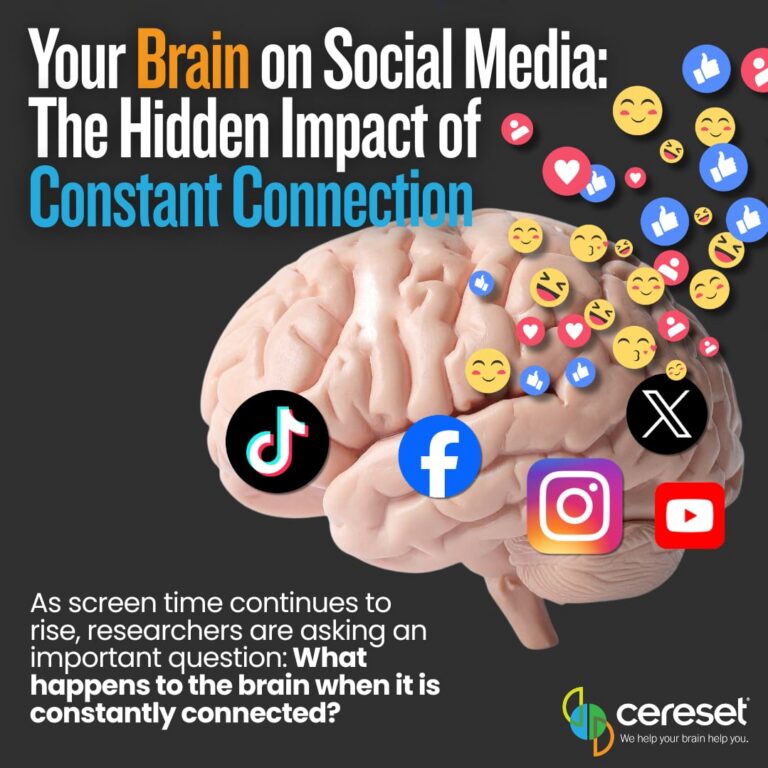
Over the past 20 years, social media has transformed nearly every aspect of our daily lives, from how we connect and communicate to how we consume information, discover the world around us, and entertain ourselves. Social media has opened new avenues that allow us to stay in touch with friends, learn new skills, discover new ideas, and share life’s biggest moments with people around the world.
At the same time, this unprecedented level of connectivity has introduced new challenges for our mental and emotional well-being. Pew Research has found that nearly half of American teens and more than 40% of adults now report being online “almost constantly.” Among teens, that number has nearly doubled in just a decade, rising from 24% in 2014–15 to 46% today.
As screen time has steadily increased across all populations, researchers have begun asking an important question: What happens to the brain when it is constantly connected?
Research does not suggest that social media is inherently harmful. However, growing evidence indicates that when social media use becomes excessive or compulsive, it can interfere with some of the brain’s most important functions, from attention and emotional regulation to healthy sleep and overall mental well-being.
Your Brain Wasn’t Designed for Constant Stimulation
Every notification, “like,” message, short-form video, and endless scroll offers the brain something it is naturally drawn to: novelty, anticipation, and the possibility of reward.
Novelty (something new) naturally captures the brain’s attention and can activate reward-related pathways in the brain. Social media platforms are particularly effective at taking advantage of this system because the rewards are unpredictable: you never know when the next interesting video, message, comment, or notification will appear.
Dopamine, a key neurotransmitter involved in motivation, reward learning, and reinforcement, plays an important role in this process. When an activity repeatedly produces quick and easily accessible rewards, the brain can learn to seek that activity again and again.
This does not mean that every social media interaction causes a damaging “dopamine hit,” nor does social media use automatically lead to addiction. However, repeated exposure to rapid, highly stimulating, and easily accessible rewards can reinforce habitual behaviors, such as constantly checking notifications or compulsively scrolling. Over time, this pattern may make immediately rewarding activities increasingly appealing while reducing tolerance for slower, more effortful activities where the reward is delayed. The result can be a vicious cycle: check, scroll, receive a brief reward, become bored again, and reach for the phone once more.
Over time, this constant stream of stimulation may make it harder to tolerate quiet moments void of stimulation, maintain sustained attention, or remain engaged in activities that require patience, deeper concentration, and delayed rewards.
Boredom: The Long-Lost Art
One of the more subtle consequences of constant connectivity may be the gradual disappearance of boredom.
Those who grew up before smartphones probably remember long family road trips spent staring out the window, daydreaming, watching the scenery pass by, or inventing silly games just to pass the time. Waiting in line, sitting in a waiting room, or simply having nothing to do meant being left alone with our thoughts. In the past, these were regular opportunities for self-reflection, imagination, creativity, or simply connecting with ourselves in a different way.
Today, many of those once-empty moments are immediately filled by our smartphones.
At the first hint of boredom, we can scroll, watch, read, play, or check for something new. As a result, we have become remarkably good at eliminating boredom.
The problem is that mental downtime may be more important for the brain than we realize. Those seemingly unproductive moments can serve an important purpose, creating space for the mind to wander, reflect, process experiences, make connections, and generate new ideas.
When our attention is not focused on a demanding external task, a collection of interconnected brain regions known as the Default Mode Network, or DMN, tends to become more active.
The DMN is involved in many important internally focused mental processes, including:
- Reflecting on past experiences and autobiographical memories
- Processing emotions and social experiences
- Thinking about ourselves and other people
- Connecting ideas, memories, and experiences
- Imagining possible future events
- Thinking about and planning for the future
- Supporting certain forms of creativity and insight
In many ways, the Default Mode Network helps the brain turn inward, reflecting on experiences, making connections, imagining possibilities, and constructing our sense of self. Its functions are closely tied to self-referential thinking, social cognition, memory, and future-oriented thought, and interactions between the DMN and other brain networks appear to contribute to creative thinking.
But when we automatically reach for our phones to fill every quiet moment, we may be replacing some of these opportunities for internally directed thought and reflection with a continuous stream of external stimulation.
And for developing brains, this may be especially important. Adolescence is a critical period of brain development, when the networks involved in self-reflection, emotional processing, impulse control, social understanding, and cognitive control are still maturing.
That raises important questions about what constant stimulation may mean for healthy brain development.
Social Media and Mental Health: What the Research Shows
One of the largest analyses of social media and mental health reviewed:
182 studies involving more than 1.16 million participants.
Rather than asking whether social media is simply “good” or “bad,” researchers examined how different patterns of use were associated with mental health.
The findings revealed an important distinction.
General social media use showed relatively small associations with depression and anxiety. However, problematic social media use, such as compulsive checking, difficulty disengaging (“doomscrolling”), or allowing social media usage to interfere with everyday responsibilities and tasks, showed more consistent associations with:
- Higher depressive symptoms
- Increased anxiety
- Poorer overall well-being
- More sleep-related problems
That distinction matters.
The issue is not simply whether you use social media; it is how you use it, how much control you have over it, and, more importantly, what other healthy or positive activities it begins to replace in your life.
Why Sleep May Be the Missing Piece
Some of the brain’s most important restorative processes occur while we sleep.
During healthy sleep, the brain:
- Consolidates memories and information
- Processes emotional experiences
- Supports learning
- Clears away metabolic waste
- Supports neuroplasticity
- Helps restore attention and cognitive performance
Unfortunately, excessive social media use can easily begin competing with sleep.
We have all likely experienced the familiar thought: “I’ll just scroll for a few minutes.”
Then suddenly, an hour has passed, then two, then three…
Because social media provides a virtually endless stream of novelty, there is rarely a natural stopping point. Unlike finishing a television episode, reading the final page of a chapter, or completing a task, the feed simply continues.
Before long, time that could have been spent sleeping, exercising, connecting with others in person, reading, or pursuing hobbies is consumed by scrolling.
Multiple systematic reviews have found that excessive or problematic social media use is associated with poorer sleep quality. Poor sleep, in turn, is strongly associated with problems involving mood, anxiety, attention, stress regulation, and emotional resilience.
In other words, the relationship between social media and mental health may not simply be: Social media → poorer mental health
For some people, part of the pathway may look more like: Excessive social media → poor sleep habits → difficulties with emotional and cognitive functioning
Sleep may therefore be one of the most important links connecting problematic social media use with brain health.
Can Social Media Affect Attention and Focus?
Heavy social media users are now describing a similar but concerning experience:
- They sit down to read a book but quickly feel restless and impatient.
- They begin a project or task but instinctively reach for their phone before it’s completed.
- They watch a longer video, show, or movie and feel tempted to skip ahead.
- They struggle to sit quietly or complete simple routine tasks like brushing their teeth without external stimulation.
In short, they are noticing a lower tolerance for tasks that require sustained attention and prolonged focus, and emerging research suggests there may be good reason to take these warning signs seriously.
Social media constantly demands that the brain rapidly shift its attention and focus; jumping from one video to the next, one notification to another, one message to another, and often between completely unrelated topics. Short-form content can take this even further. Within a matter of minutes, someone might move from a comedy video to breaking news, then to a cooking demonstration, an advertisement, a political argument, a vacation video, and a message from a friend.
That is an enormous amount of novelty and information packed into a very short period of time.
However, the brain is also highly adaptable, and as such, it becomes more efficient at behaviors we repeatedly practice.
If we spend hours repeatedly practicing rapid shifts in attention, the brain may become increasingly adapted to environments that provide constant novelty, stimulation, and frequent changes in focus. As a result, we may become more impatient with, and less tolerant of, activities that require sustained attention.
While more research is needed to establish exactly how these patterns affect attention over the long term, studies have linked increasing social media use during adolescence with greater attention problems over time.
Here’s the key: The brain adapts to what we repeatedly ask it to do.
If we constantly practice distraction, then sustained attention may become harder. On the flip side, if we regularly practice sustained focus, our capacity for deeper attention can improve.
Does Social Media Cause Depression?
This is one of the most commonly asked questions regarding social media usage, and one of the easiest to oversimplify.
Current research does not prove that social media directly causes depression; however, there are important nuances.
Mental health is a complex issue, influenced by many factors such as genetics, relationships, sleep habits, stress load, trauma history, physical health, environment, and many other factors.
However, longitudinal research on this topic gives us an important clue: some studies have found that higher social media use predicts increases in depressive symptoms over time, whereas depressive symptoms do not consistently predict subsequent increases in social media use.
This does not prove that social media causes depression, but it strengthens the possibility that excessive social media exposure may contribute to worsening mental health for some individuals, particularly those already dealing with other factors associated with depression, such as past trauma, chronic stress, or poor sleep.
There are several potential reasons why this may happen. Social media can:
- Encourage constant comparison.
- Expose users to conflict, outrage, or frightening news.
- Present unrealistic portrayals of life.
- Interfere with sleep.
- Displace time for healthy activities like exercise, hobbies, and face-to-face interaction.
- Train attention toward a nearly continuous stream of emotionally stimulating information.
For a brain already experiencing significant stress, those factors can add up quickly, overloading an already taxed nervous system.
The Good News: Small Changes Can Make a Difference
Fortunately, you do not necessarily have to abandon social media altogether to improve your relationship with it and protect brain health.
Research suggests that simply reducing use can produce meaningful benefits.
In one randomized controlled trial, young adults who reduced their social media use for four weeks by 50% experienced improvements in several areas, including depression, anxiety, fear of missing out (FOMO), and sleep when compared with participants who continued their usual social media habits.
Reducing social media is certainly not a cure for mental health conditions, but these findings highlight something important: Giving the brain regular breaks from constant stimulation can create room for healthier behaviors to return.
When you spend less time scrolling, you also create more time for the things that consistently support better brain health, like sleep, exercise, learning, relationships, hobbies, creativity, and time outdoors.
Give Your Brain Time to Reset
The brain thrives on balance. While it needs stimulation, novelty, challenge, and social connection, it also needs quiet, calm, and space to reflect.
Importantly, the brain needs opportunities to simply be present without constantly processing incoming information.
You do not necessarily need to delete every social media account; however, it is important to become intentional about your social media usage. To help with this, consider introducing a few intentional boundaries:
- Keep your phone out of the bedroom at night.
- Avoid social media during the first and last 30–60 minutes of your day.
- Schedule regular periods of screen-free time (like family dinner).
- Turn off all nonessential notifications.
- Challenge yourself when you instinctively reach for your phone by asking, “Am I reaching for my phone to avoid something else that might be more beneficial or meaningful for me right now?”
- Make more time for face-to-face interactions.
- Read longer-form materials, like books or articles, regularly.
- Exercise and spend time outdoors regularly.
- Allow yourself to occasionally be bored without reaching for your phone.
That last one may feel surprisingly uncomfortable at first, but it’s also important. Challenge yourself to look out the window on long drives, take a walk without headphones, or simply watch the clouds go by.
Intentionally create space for your brain to reflect, without external noise. Your brain may have more important things to process than you realize.
Make Space to Disconnect
Social media has transformed communication, education, entertainment, and human connection in extraordinary ways, but like any powerful technology, research shows that how we use it matters… a lot.
The bottom line is that when social media begins interfering with your sleep, attention, mood, relationships, productivity, or ability to simply be present, it may be a sign that your brain needs more time away from constant stimulation.
Healthy brains need more than stimulation. They need reflection, focus, patience, sleep, real-world connection, and sometimes, they even need boredom. In short, brains need balance.
Making intentional time each day to disconnect may be one of the simplest things you can do to give your brain more opportunity to reset, restore, and regulate.
by Sonya Crittenden,
Director of Client Services & Education
Cereset Corporate Headquarters
Resources & Further Reading
- Pew Research Center — Teens, Social Media and Technology 2024
- Social Media Use, Mental Health and Sleep: A Systematic Review with Meta-Analyses
- 20 Years of the Default Mode Network: A Review and Synthesis
- Association of Digital Media Use With Subsequent Symptoms of ADHD Among Adolescents — JAMA
- ADHD Symptoms, Social Media Use Intensity, and Social Media Use Problems in Adolescents
- Electronic Media Use and Sleep Quality: Systematic Review and Meta-Analysis
- The Interconnected Causes and Consequences of Sleep in the Brain
- Sleep, Cerebrospinal Fluid, and the Glymphatic System: A Systematic Review
- The Longitudinal Association Between Social-Media Use and Depressive Symptoms
FIND THE CERESET CLIENT CENTER NEAREST YOU & CALL TODAY
*Cereset is not a medical provider and does not diagnose, treat, cure, or prevent concussions or any other medical condition. Any serious head injury or concussion with severe or worsening symptoms should be evaluated immediately by a licensed medical professional.